
Cost of Living in Sacramento, CA (2026): Housing, Bills, Taxes and Real Budgets
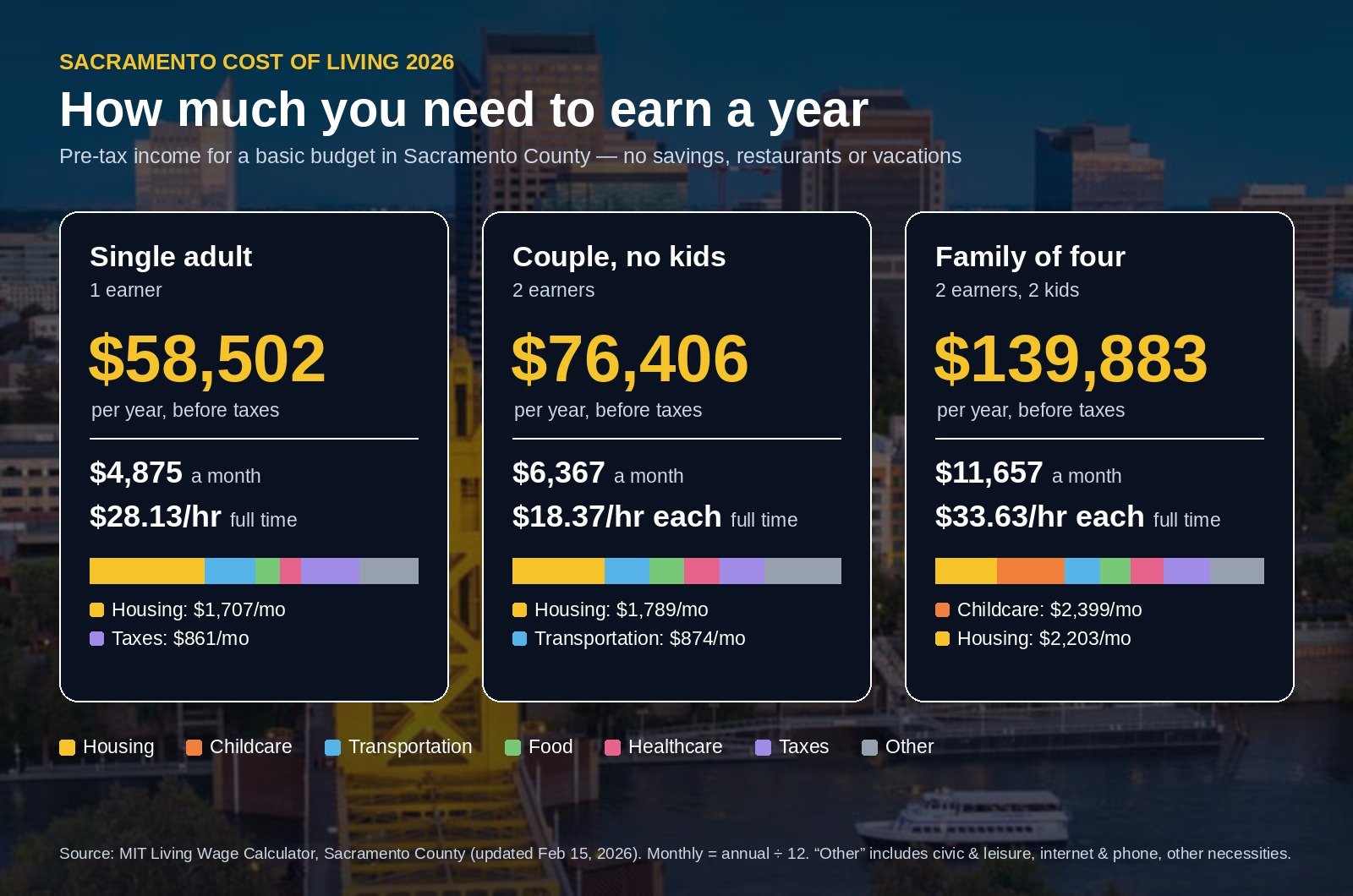
The cost of living in Sacramento, CA is above the U.S. average but far below the Bay Area and Los Angeles. Typical asking rent in the city is $2,056 a month, about 6% above the national $1,948, while the typical home is valued at $473,797, about 29% above the U.S. figure (Zillow, August 2026). A single adult needs at least $58,502 a year before taxes to cover a basic budget in Sacramento County, and a family of four with two working parents needs $139,883 (MIT Living Wage Calculator, February 2026).
Housing and childcare are the biggest expenses. Electricity and sales tax are where Sacramento is cheaper than most of coastal California. This guide breaks down each cost with its source and date; for neighborhoods, climate and jobs, see our complete guide to living in Sacramento.
How Sacramento Compares With the Bay Area and Los Angeles
| Cost | Sacramento | San Francisco | San Jose | Oakland | Los Angeles | U.S. |
| Typical home value (Zillow, Aug 2026) | $473,797 | $1,424,767 | $1,362,808 | $708,610 | $929,572 | $368,697 |
| Typical asking rent (Zillow, Aug 2026) | $2,056 | $4,682 | $3,563 | $2,735 | $2,778 | $1,948 |
| Avg. 750 kWh electric bill (June 2026) | $149 (SMUD) | $290 (PG&E) | $290 (PG&E) | $290 (PG&E) | $217 (LADWP) | — |
| Sales tax (Oct 2026) | 8.75% | 8.625% | 10.00% | — | 10.25% | — |
| Median household income (ACS 2024) | $91,387 | $139,801 | $148,226 | — | $82,263 | $81,604 |
At typical asking rents, a renter moving from San Francisco saves about $31,500 a year, from San Jose about $18,100, and from Los Angeles or Oakland about $8,100–8,700 (calculated from Zillow ZORI, August 2026). The electricity gap adds roughly $1,700 a year in savings compared with PG&E at 750 kWh a month.
The catch is income. Local salaries are lower than in the Bay Area, so the biggest gains go to people who keep a Bay Area paycheck and work remotely or hybrid.
How Much Money Do You Need to Live in Sacramento?
The MIT Living Wage Calculator estimates the minimum pre-tax income needed to cover basic costs in Sacramento County, with no savings, restaurant meals or vacations. Treat these numbers as a floor, not a comfortable budget.
| Monthly cost (MIT annual ÷ 12) | Single adult | Couple, both working, no kids | Couple, both working, 2 kids |
| Housing | $1,707 | $1,789 | $2,203 |
| Food | $369 | $677 | $1,080 |
| Childcare | $0 | $0 | $2,399 |
| Healthcare | $320 | $682 | $1,163 |
| Transportation | $755 | $874 | $1,267 |
| Civic and leisure | $323 | $545 | $819 |
| Internet and phone | $123 | $175 | $175 |
| Other necessities | $416 | $756 | $900 |
| Taxes | $861 | $868 | $1,650 |
| Total pre-tax income needed | $4,875 | $6,367 | $11,657 |
| Annual equivalent | $58,502 | $76,406 | $139,883 |
Monthly figures are calculated by dividing MIT’s annual Sacramento County estimates (updated February 15, 2026) by 12.
In hourly terms, a single adult working full time needs $28.13 an hour, well above the $16.90 minimum wage MIT uses for the county. In a family with two working parents and two children, each parent needs $33.63 an hour.
How local salaries compare. Typical annual salaries in Sacramento County include $186,670 for legal jobs, $167,520 in management, $149,800 in computer and math jobs, $131,360 for healthcare practitioners, $106,440 in business and finance, $80,140 in education, $77,920 in construction, $57,810 in office support and $42,530 in food service (MIT, based on BLS data). A single office-support worker sits just under the basic single-adult budget; a single food-service worker falls well short of it.
Rent versus income. At the median household income of $91,387 (Census ACS 2024), typical asking rent of $2,056 takes about 27% of gross income, under the common 30% guideline. A household earning less than about $82,000 would spend more than 30% on that rent.
Housing Costs in Sacramento
Housing is the largest single expense for most households: in MIT’s single-adult budget it takes 35% of the required pre-tax income.
Rent by apartment size
Two sources measure rent differently. Zillow’s Observed Rent Index tracks asking rents on new listings: $2,056 a month in the city in August 2026, up 1.2% from a year earlier. The Census counts what all renters pay, including long-term leases, so its figures are lower.
| Unit size | Median gross rent, Sacramento (ACS 2024) | California | U.S. |
| Studio | $1,620 | $1,654 | $1,321 |
| 1 bedroom | $1,617 | $1,835 | $1,301 |
| 2 bedrooms | $1,917 | $2,179 | $1,490 |
| 3 bedrooms | $2,170 | $2,431 | $1,677 |
| 4 bedrooms | $2,191 | $2,854 | $2,069 |
Gross rent includes utilities the renter pays. Expect a newly listed unit to cost more than these medians.
The suburbs are not automatically cheaper to rent. Typical asking rent is $2,263 in West Sacramento, $2,422 in Rancho Cordova, $2,569 in Roseville, $2,627 in Folsom and $2,716 in Elk Grove, all above the city’s $2,056 (Zillow ZORI, August 2026).
Buying a home and property taxes
The typical home in the city is valued at $473,797, down 0.9% year over year, versus $574,820 across the metro, $626,316 in Elk Grove, $645,119 in Roseville and $753,276 in Folsom (Zillow ZHVI, August 2026). Buying inside city limits is the lowest-cost entry point in the region.
Property taxes follow Proposition 13. The base rate is 1% of assessed value, plus voter-approved local charges such as school or infrastructure bonds. Assessed value is set at purchase and can rise no more than 2% a year until the home is sold. Because local charges vary by parcel, check the tax bill for any specific address with the Sacramento County Assessor and Tax Collector before you make an offer.
The takeaway: renting in the city is cheaper than renting in most suburbs, while buying in the city costs $100,000 or more less than the metro’s typical home.
Utilities: SMUD, PG&E and Summer Bills
Electricity in the city of Sacramento comes from SMUD (Sacramento Municipal Utility District), a public utility, not from PG&E. Natural gas comes from PG&E. Water, sewer and garbage service inside city limits is billed by the City of Sacramento Department of Utilities.
| Electric provider | Average monthly bill, 750 kWh (June 1, 2026) |
| SMUD (Sacramento) | $149 |
| Roseville Electric | $156 |
| LADWP (Los Angeles) | $217 |
| Southern California Edison | $283 |
| PG&E (most of the Bay Area) | $290 |
| SDG&E (San Diego) | $322 |
Source: SMUD residential rate comparison.
Summer is when bills climb, because air conditioning runs through the hottest months. On SMUD’s standard Time-of-Day rate, summer electricity (June 1 to September 30) costs $0.1550 per kWh off-peak, $0.2139 mid-peak and $0.3765 during the weekday peak from 5 to 8 p.m. From October through May, the rates drop to $0.1285 off-peak and $0.1776 peak (SMUD, 2026).
Pre-cooling your home before 5 p.m. and running the dishwasher, dryer and EV charger after 8 p.m. moves usage out of the most expensive window, where each kWh costs more than twice the off-peak price.
Taxes in Sacramento
Sales tax. The combined rate in the city of Sacramento is 8.75% as of October 1, 2026 (CDTFA). Rates differ across the region:
| City | Sales tax rate |
| Roseville, Folsom, Citrus Heights | 7.75% |
| San Francisco | 8.625% |
| Sacramento, Elk Grove, Rancho Cordova | 8.75% |
| West Sacramento | 9.25% |
| San Jose | 10.00% |
| Los Angeles | 10.25% |
For most purchases, the rate depends on where you buy, not where you live (vehicles are the exception: they are taxed at the rate where you register them), so a large purchase such as furniture or appliances costs 1 percentage point less in tax in Roseville or Folsom.
State income tax. California taxes income on a progressive scale, and the same brackets apply in Sacramento as anywhere else in the state. There is no separate city income tax. Check the current brackets for your filing status on the California Franchise Tax Board website.
Property tax. Covered above: a 1% base rate under Proposition 13 plus local voter-approved charges, with the exact amount set by parcel.
Transportation, Food, Healthcare and Childcare
Transportation. MIT budgets 9,065ayear(755 a month) for a single adult and 15,205(1,267 a month) for a family of four in Sacramento County. In Sacramento a car is hard to avoid: 66.3% of working city residents drive to work alone and 2.2% take public transit (Census ACS 2024). Living and working in Midtown or Downtown is the main way to cut this line.
Food. MIT’s basic food budget is 4,428ayearforasingleadult(369 a month) and 12,960forafamilyoffour(1,080 a month). These figures assume cooking at home; restaurant meals come on top.
Healthcare. Basic healthcare costs, including premiums and out-of-pocket spending, run $3,846 a year for a single adult and $13,961 for a family of four (MIT, 2026).
Childcare. For two working parents with two children, MIT estimates $28,792 a year for childcare, or about $2,399 a month. That is more than the same family’s housing budget of $26,431 and about one-fifth of its total required income.
The takeaway: after rent, a car and childcare decide whether a Sacramento budget works. Families should price daycare before choosing a neighborhood.
How to Lower Your Cost of Living in Sacramento
- Rent inside city limits. Typical asking rent in the city ($2,056) is lower than in Elk Grove, Folsom, Roseville, Rancho Cordova or West Sacramento (Zillow, August 2026).
- Live near work to drop a car. In Midtown or Downtown, going down to one car or none cuts into the $9,065 a year MIT budgets for a single adult’s transportation.
- Shift electricity use out of 5–8 p.m. in summer. SMUD’s weekday peak rate is $0.3765 per kWh, more than double the off-peak $0.1550.
- Make large purchases in a 7.75% city. Roseville, Folsom and Citrus Heights charge 1 point less sales tax than Sacramento.
- Look up the tax bill before buying. Under Proposition 13, local charges vary by parcel, so two homes at the same price can carry different annual taxes.
- Keep a Bay Area salary if you can. Remote and hybrid workers capture the full housing gap: 16.2% of city workers already work from home (Census ACS 2024).
Common budgeting mistakes
- Using old rent data. Medians from long-term leases ($1,617 for a one-bedroom, ACS 2024) understate what a new lease costs; budget from current listings.
- Comparing cities on rent alone. A move from PG&E territory to SMUD lowers a typical electric bill from $290 to $149 a month.
- Forgetting childcare. For a family of four it can exceed housing.
- Assuming the suburbs are cheaper. In August 2026, typical asking rent in every nearby suburb Zillow tracks was higher than in the city.
Moving to Sacramento on a Budget
The cost of the move itself depends on the season, the size of your home and access at both ends. Our guide to the best time to move in Sacramento explains how timing affects price and availability.
If you are renting, check the building’s rules early. Many complexes require an elevator reservation and a move during office hours, and condo HOAs may require proof of the mover’s insurance and set fixed time slots; our article on why apartment moves in Sacramento are more complicated covers what to ask. Families comparing school districts and budgets can also review our list of the top Sacramento suburbs for families.
To know your moving cost upfront, get a free estimate from our Sacramento team.
Frequently Asked Questions About the Cost of Living in Sacramento
Is Sacramento expensive to live in?
It is more expensive than the U.S. average and cheaper than most of coastal California. Typical asking rent is $2,056 a month in the city versus $1,948 nationally, $2,778 in Los Angeles and $4,682 in San Francisco (Zillow, August 2026).
What salary do you need to live comfortably in Sacramento?
The minimum for basic needs is $58,502 a year before taxes for a single adult and $139,883 for two working parents with two children (MIT Living Wage Calculator, 2026). A comfortable life with savings and leisure requires a higher income than these minimums.
How much is rent in Sacramento?
New listings in the city ask about $2,056 a month on average (Zillow ZORI, August 2026). Across all current leases, the median is $1,617 for a one-bedroom and $1,917 for a two-bedroom (Census ACS 2024).
Is Sacramento cheaper than San Francisco?
Yes. The typical home costs about one-third as much ($473,797 vs. 1,424,767),andtypicalaskingrentislessthanhalf(2,056 vs. $4,682), based on Zillow data for August 2026.
Is Sacramento cheaper than Los Angeles?
Yes for housing: typical home values are about half of Los Angeles’s, and rent is about 720amonthlower.MedianhouseholdincomeishigherinSacramento(91,387 vs. $82,263, ACS 2024).
How much are utilities in Sacramento?
A household using 750 kWh of electricity a month pays about $149 to SMUD, compared with $290 to PG&E (SMUD, June 2026). Gas comes from PG&E, and water, sewer and garbage are billed by the city.
How much does childcare cost in Sacramento?
MIT estimates $28,792 a year for two children in Sacramento County, about $2,399 a month. For a family of four, that is more than the basic housing budget.
Is it cheaper to rent or buy in Sacramento?
It depends on how long you stay and your down payment. Renting inside the city is cheaper than in the suburbs, and buying inside the city is the lowest-cost entry point in the region, at a typical home value of $473,797 (Zillow, August 2026).
In short: Sacramento costs more than the average U.S. city but far less than the Bay Area or Los Angeles. A single adult needs at least $58,502 a year before taxes, housing takes the largest share, and SMUD electricity and an 8.75% sales tax keep everyday bills below coastal levels. Families should plan around childcare, which can cost more than housing.
Budget checklist before you move:
- Compare current listings, not old medians, for the unit size you need.
- Add a summer electricity estimate using SMUD rates, plus PG&E gas.
- Price childcare near your future home and workplace.
- Decide whether you need one car, two or none.
- Look up the property tax bill for any home you plan to buy.
- Check that your income covers the MIT basic budget with room for savings.
Sources (data accessed October 21, 2026): Zillow Research — ZHVI and ZORI; MIT Living Wage Calculator — Sacramento County; U.S. Census Bureau — American Community Survey 2024; SMUD — Residential Rates; CDTFA — Sales and Use Tax Rates; California Franchise Tax Board; Sacramento County Assessor.